
Choosing the right rug for a narrow living room is one of those decisions that looks simple until you’re standing in a long thin room holding a tape measure and questioning every choice you’ve ever made. The wrong rug size, shape, or placement in a narrow space doesn’t just look off, it actively makes the room feel more awkward than it did with bare floors. The right rug, on the other hand, can visually widen the room, anchor the furniture, and make the whole space feel genuinely pulled together.
Most narrow living rooms sit somewhere between 8 and 12 feet wide, which rules out the oversized square rugs that work so well in standard proportioned rooms. The challenge is finding something that works with the long rectangular footprint rather than fighting against it. I’ve seen narrow living rooms styled beautifully with everything from a single long runner to two smaller rugs placed end to end, and the difference between a room that works and one that doesn’t almost always comes down to rug choice.
This guide covers the best rug sizes, shapes, and placement strategies for long narrow living rooms, along with pattern and color advice that actually helps rather than just stating the obvious. Every idea here works in a real home, not just in a perfectly lit showroom.
Why Rug Choice Matters More in a Narrow Living Room Than Any Other Space
A rug in a narrow living room does more visual work than in any other room shape. In a standard square or gently rectangular room, a rug mostly just adds warmth and texture. In a narrow room, it either reinforces the awkward proportions or actively corrects them. That’s a lot of responsibility for something you wipe your feet on.
The proportions of the rug relative to the room shape determine whether the space feels balanced or lopsided. A rug that’s too small floats in the middle of the floor and makes the room look even longer and thinner by comparison. A rug that’s too wide creates a cramped corridor effect that emphasises exactly what you’re trying to avoid. Getting the width right is more important than getting the length right in a narrow room.
Color and pattern choices amplify the effect significantly. Horizontal stripes running across the width of the room create an optical illusion that pushes the walls apart visually. Dark rugs absorb floor space and can make a narrow room feel like a tunnel. Light, warm-toned rugs reflect light and make the floor feel broader. These aren’t decorating myths, they’re genuinely reliable visual tricks that work consistently in real spaces.
7 Best Rug Ideas for Narrow and Long Living Rooms
1. A Single Large Rectangular Rug Placed Lengthways
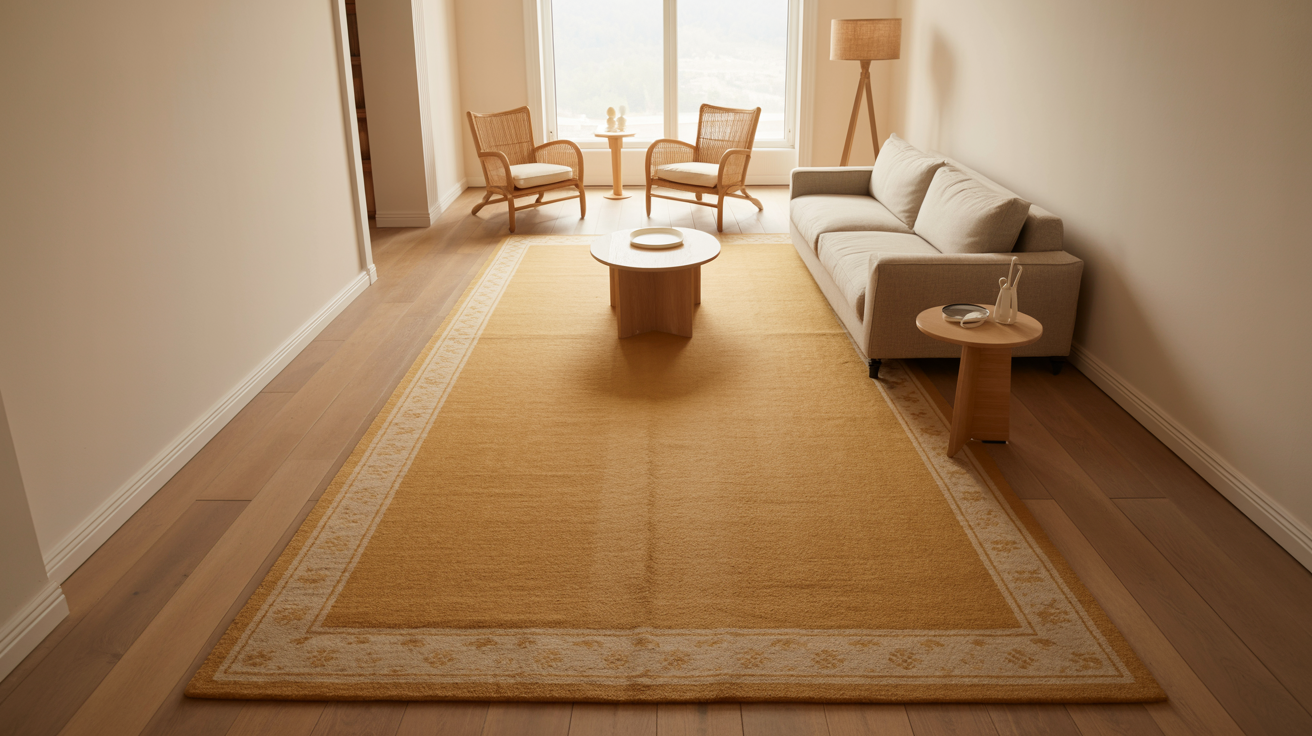
A large rectangular rug running lengthways down the room is the most straightforward approach and often the most effective one. The key is choosing a rug wide enough to sit under the front legs of both the sofa and the chairs facing it, which grounds the seating area and makes it feel like a defined zone rather than furniture floating in a corridor.
For most narrow living rooms, a rug between 8×10 feet and 9×12 feet works well as the primary floor covering. The width of the rug should ideally leave between 12 and 18 inches of bare floor showing on each side. Any less and the room feels cramped. Any more and the rug looks like it belongs in a different, wider room.
The pattern on a lengthways rectangular rug matters more than people realise. A rug with a horizontal pattern, stripes, geometric repeats, or a border design that draws the eye across the width rather than along the length visually widens the room. Avoid strong vertical patterns or long linear designs that run parallel to the walls, as these pull the eye along the length and make the room feel even more tunnel-like.
2. Two Matching Rugs Placed End to End
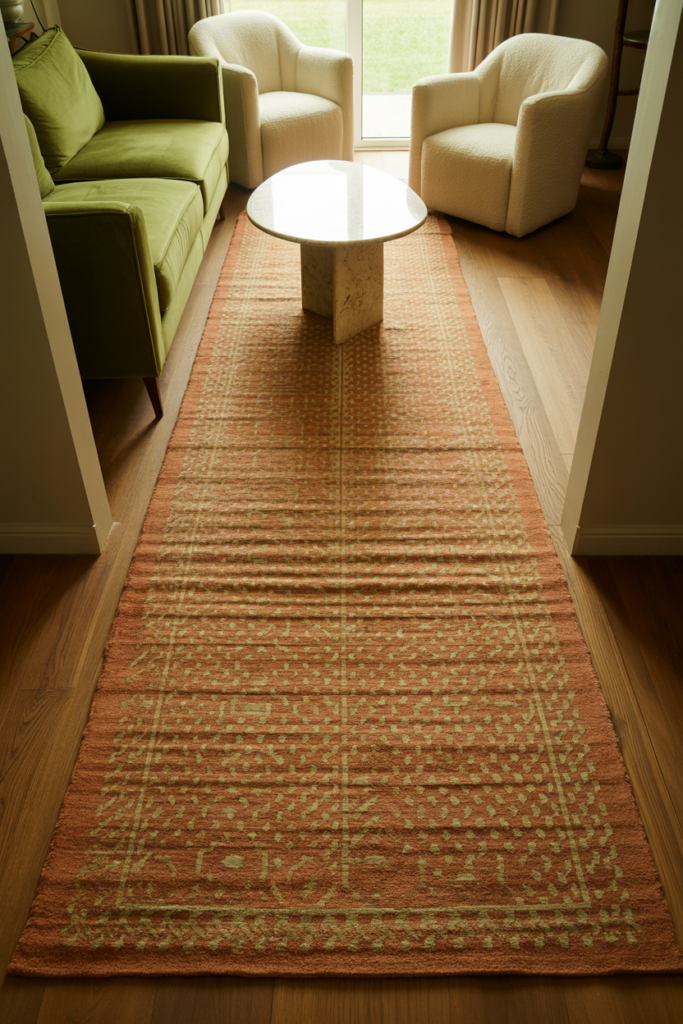
Two identical or closely matched rugs placed end to end down the length of the room is a clever approach that suits narrow living rooms used for two distinct activities, such as a seating area at one end and a reading or TV area at the other. It defines two zones within the one long room without using a physical divider, and it gives the space a layered, considered quality that a single rug rarely achieves.
The gap between the two rugs should be kept small, between two and four inches, so the floor reads as two connected zones rather than two completely separate spaces. Using rugs with the same base color but slightly different patterns works beautifully here. It creates visual interest without making the room feel chaotic.
This approach also solves a practical problem in very long narrow rooms where a single rug of the right dimensions is either unavailable or prohibitively expensive. Two 5×8 foot rugs often cost less combined than one 9×12, and they give more flexibility for future rearrangements. It’s one of those solutions that looks like a deliberate style choice rather than a workaround.
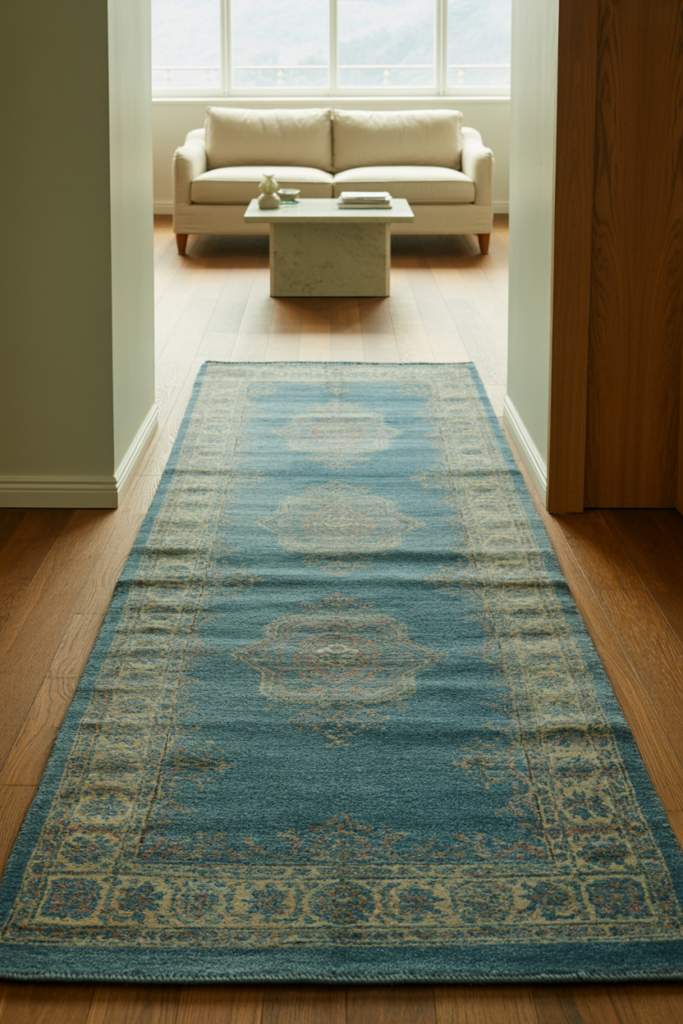
3. A Long Hallway Runner Down the Center
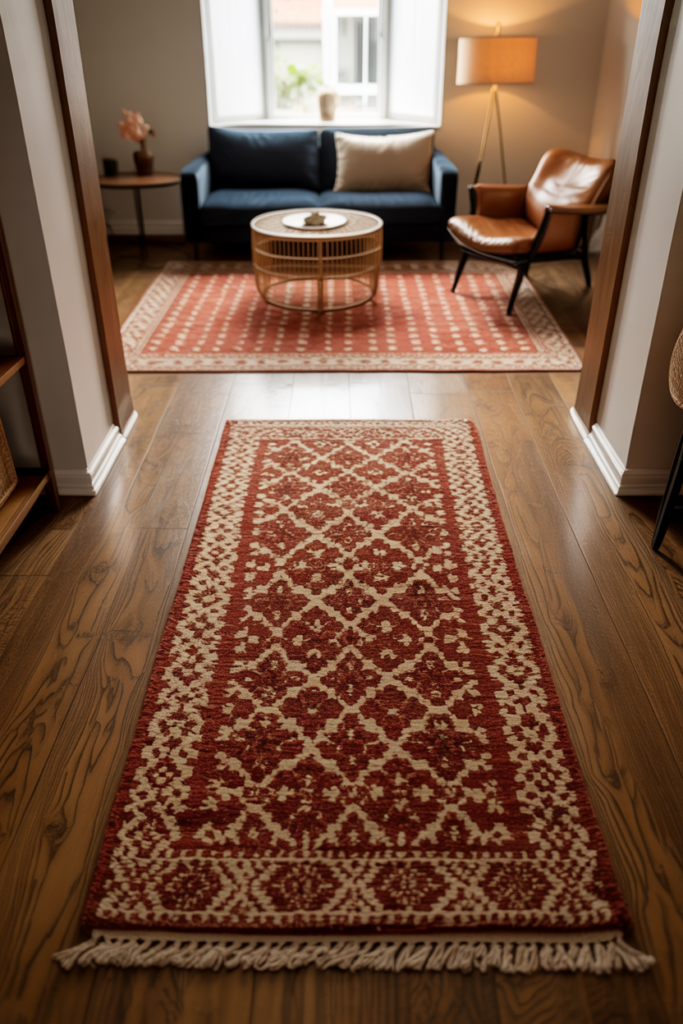
A hallway runner used intentionally in a narrow living room sounds unconventional, but it works surprisingly well in the right context. A runner between 2.5 and 3 feet wide and 10 to 14 feet long placed down the center of the room creates a strong central axis that gives the long space a sense of direction and purpose. It works particularly well in industrial, Scandinavian, or minimalist living rooms where the clean graphic line of a runner reads as an intentional design choice.
The runner works best when the furniture sits alongside it rather than on top of it. Sofas and chairs placed with their front legs off the runner on either side frame the central strip and make the layout feel considered. This approach leaves more floor visible than a wide area rug, which suits rooms where the flooring itself is beautiful enough to show.
Pattern choice for a runner in a living room context matters enormously. A geometric pattern or a bold stripe running across the width of the runner rather than along its length keeps the eye moving side to side rather than straight down the room. A plain runner in a warm neutral tone is always a safe choice if you’re unsure, and it complements almost any furniture style without competing.
4. A Wide Rug Placed Across the Width to Zone the Seating Area
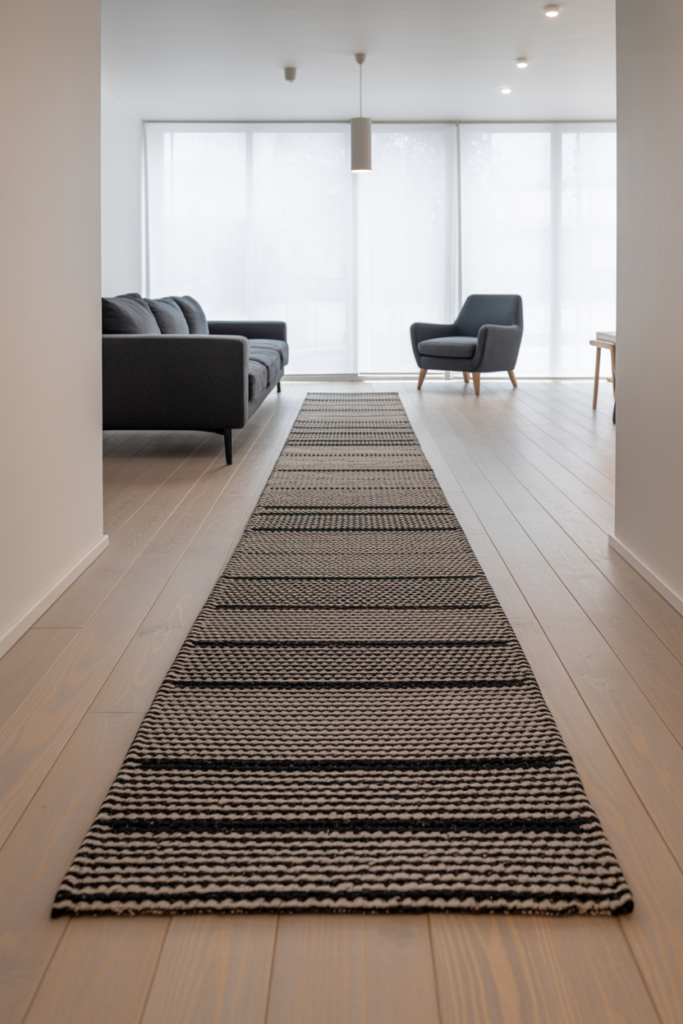
Placing a rug across the width of the room rather than along its length is a counterintuitive move that works extremely well in narrow spaces. A rug oriented with its longer dimension running wall to wall, or close to it, creates a wide horizontal band on the floor that pushes the walls apart visually. This is one of the most effective optical tricks available for a long thin room and one that doesn’t get nearly enough attention.
For this to work, the rug needs to be wide enough to span most of the room’s width and short enough in the other dimension to sit clearly within the seating area. A 9×6 foot rug placed with the 9-foot side running across the width of an 11-foot wide room covers most of the floor width and creates a strong horizontal visual that counteracts the room’s length effectively.
The furniture arrangement for this approach places the sofa against the long wall with its back parallel to the rug’s shorter edges. The rug then sits in front of the sofa and under the coffee table. This feels slightly unusual to set up but looks completely natural and well-proportioned once the room is furnished.
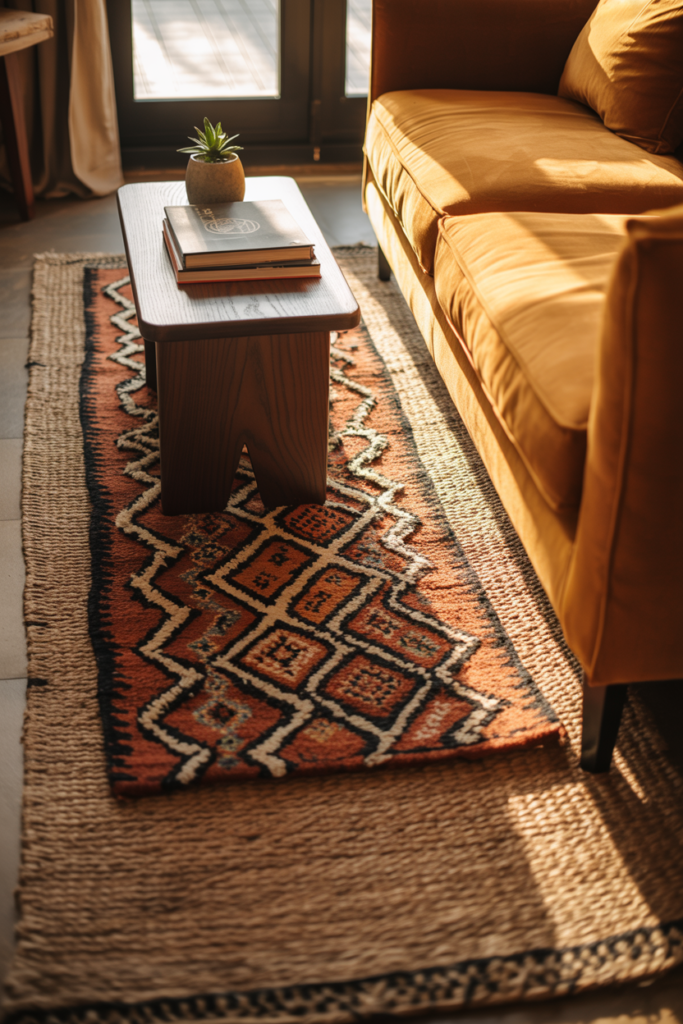
5. Layered Rugs for Texture and Visual Width
Layering a smaller rug on top of a larger flat-woven base rug is a styling technique that adds tremendous warmth and texture to a narrow living room while giving more flexibility with sizing than a single rug allows. The base rug can be a large natural fiber option like jute or sisal that covers most of the floor area, and a smaller, more decorative rug sits centered on top within the seating zone.
The layering approach works especially well in neutral or earthy-toned living rooms where texture carries more visual interest than color or pattern. A flat natural jute base rug paired with a smaller Moroccan-style or Persian-inspired rug on top creates a rich, layered floor treatment that looks expensive and considered. The contrast of textures adds depth to the floor zone without adding visual noise to an already narrow space.
Practically speaking, layering also lets you use a smaller statement rug that would look lost on its own in a larger space. A beautiful 5×8 rug that wouldn’t anchor a full seating arrangement on its own looks perfectly proportioned when layered over a larger neutral base. It’s a genuinely useful trick for anyone who has fallen in love with a rug that’s just slightly too small for the room.
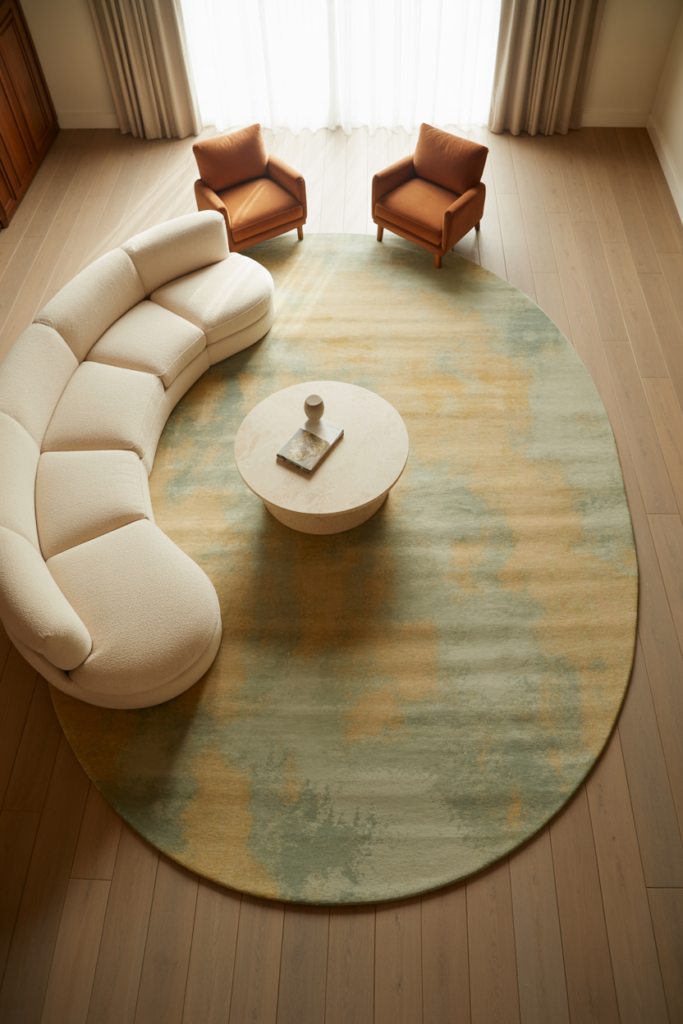
6. A Round Rug to Break Up the Linear Proportions
A round rug in a long narrow living room sounds like exactly the wrong choice, and that’s part of why it works so well. The circular shape provides a strong visual contrast to the rectangular proportions of the room and immediately draws the eye to the center of the seating arrangement rather than along the length of the space. It interrupts the tunnel effect that long thin rooms naturally create.
Round rugs work best in narrow living rooms when the seating arrangement is relatively compact and centered. A round rug between 6 and 8 feet in diameter sits well under a coffee table with the front legs of surrounding furniture just touching or slightly overlapping the edge. The circular shape reads as a deliberate focal point rather than a compromise on size.
Color and pattern matter more with round rugs than with rectangular ones in this context. A round rug in a warm mid-tone with a subtle pattern or a solid color keeps the focus on the shape itself without adding visual noise. Avoid very bold or busy patterns on round rugs in narrow rooms, as the combination of an unusual shape and a strong pattern can feel overwhelming in a tight space.
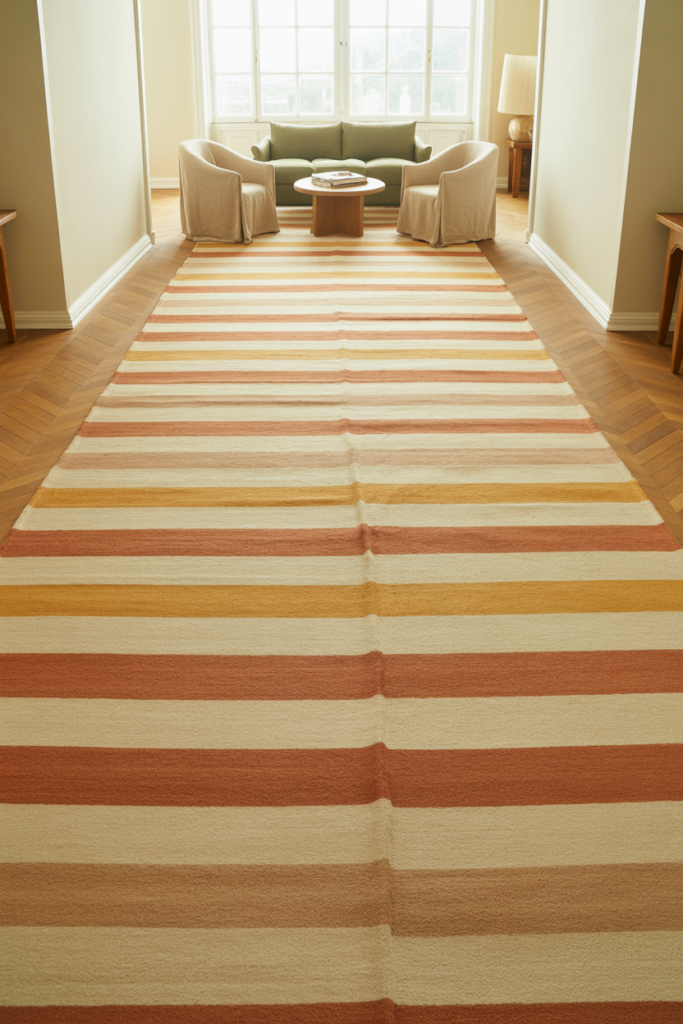
7. Horizontal Stripe Rugs to Visually Widen the Room
A rug with strong horizontal stripes running across the width of the room is one of the most reliable visual tools for making a narrow living room feel wider. The stripes direct the eye from side to side rather than front to back, and the repetition of horizontal lines across the floor creates an impression of width that overrides the brain’s reading of the room’s actual dimensions. It genuinely works, and it works every time.
The stripes need to run perpendicular to the longest walls to achieve the widening effect. If the stripes run parallel to the long walls, the opposite happens and the room looks even longer and narrower. This sounds obvious but it’s easy to get wrong when you’re unrolling a rug in a hurry. Always check the stripe direction before you commit to a placement.
Bold, high-contrast stripes in two colors create the strongest widening effect. Subtler tonal stripes in similar shades give a softer version of the same result that suits more refined or neutral room palettes. Either approach works, and the choice depends on how much visual energy you want the rug to contribute to the overall room scheme.
| Rug Idea | Best Room Width | Recommended Size | Visual Effect |
|---|---|---|---|
| Single large rectangular rug | 10 to 14 feet | 8×10 or 9×12 feet | Grounds seating, defines zone |
| Two matching rugs end to end | 12 to 18 feet | Two x 5×8 feet | Creates two zones, adds depth |
| Hallway runner down center | 8 to 11 feet | 2.5×12 or 3×14 feet | Strong central axis, modern feel |
| Wide rug across the width | 10 to 13 feet | 9×6 feet crossways | Pushes walls apart visually |
| Layered rugs | Any width | Large base plus small top | Adds texture and warmth |
| Round rug | 10 to 13 feet | 6 to 8 feet diameter | Breaks linear proportions |
| Horizontal stripe rug | 8 to 12 feet | 8×10 or 9×12 feet | Widens room optically |
Quick Rug Buying Tips for Narrow Living Rooms
Always measure the room before buying and mark the rug dimensions on the floor with masking tape before committing to a purchase. It takes five minutes and saves an enormous amount of disappointment when the rug arrives and turns out to be either too small or unexpectedly large in the actual space. I cannot overstate how useful this simple step is.
Natural fiber rugs like jute, sisal, and seagrass are worth considering in narrow rooms because their flat, low-pile construction makes the floor feel open rather than heavy. They also work as excellent layering bases. Avoid very thick, high-pile rugs in narrow rooms as the visual bulk adds to the sense of tightness rather than relieving it.
Lighter rug colors generally work better in narrow living rooms than very dark ones. A dark rug absorbs floor space visually and can make a narrow room feel like a corridor regardless of its size or shape. Warm neutrals, soft creams, and medium tones all keep the floor feeling open and the room feeling proportionally balanced.
Conclusion
Getting the rug right in a narrow living room transforms how the whole space feels, and the good news is that there are genuinely great options at every budget and style level. A single large rectangular rug laid lengthways grounds the seating area cleanly. Two matching rugs define separate zones in a longer room. A runner creates a strong architectural line that suits minimal and industrial spaces. Placing a wide rug across the room’s width rather than along it is one of the most effective visual tricks available. Layering adds texture and flexibility. A round rug breaks the linear proportions dramatically. Horizontal stripes widen the room every single time.
The most important things to get right are width, pattern direction, and placement relative to the furniture. A rug that sits under the front legs of the main seating pieces always looks more intentional than one that floats in the middle of the floor. And a rug with horizontal pattern elements will always make the room feel wider than one with vertical or lengthways lines.
Start by measuring your room carefully and marking out the rug size on the floor before buying anything. That one step alone will save you from the most common and frustrating rug mistakes in a narrow living room.
Frequently Asked Questions
What size rug works best in a narrow living room? An 8×10 or 9×12 foot rectangular rug works well in most narrow living rooms as a single area rug. The rug width should leave around 12 to 18 inches of bare floor visible on each side for the best proportional balance.
Should a rug in a narrow living room run lengthways or across the room? Both approaches work depending on the effect you want. Running the rug lengthways grounds the seating area naturally. Placing it across the width visually pushes the walls apart and makes the room feel wider, which is often the better choice in very narrow spaces.
Can you use two rugs in a long narrow living room? Yes, two matching or coordinating rugs placed end to end work very well in longer narrow rooms. Keep a small gap of two to four inches between them and use rugs with a similar color base to keep the floor reading as a cohesive zone.
Do round rugs work in narrow living rooms? Round rugs work surprisingly well in narrow living rooms because the circular shape contrasts with the rectangular proportions and draws the eye to the center of the seating area. Choose a diameter between 6 and 8 feet for most standard narrow rooms.
What rug colors work best in a narrow living room? Light to medium tones work better than dark colors in narrow rooms. Warm neutrals, soft creams, and mid-toned rugs keep the floor feeling open. Dark rugs absorb visual floor space and can make a narrow room feel like a corridor.
Do stripes on a rug make a narrow room look wider? Yes, but only if the stripes run perpendicular to the long walls. Horizontal stripes crossing the width of the room direct the eye sideways and create a genuine optical widening effect. Stripes running parallel to the long walls have the opposite effect.
How much floor should show around a rug in a narrow living room? Aim for 12 to 18 inches of bare floor visible on each long side of the rug. Too little exposed floor makes the room feel cramped. Too much makes the rug look undersized and floating rather than anchored to the furniture arrangement.